



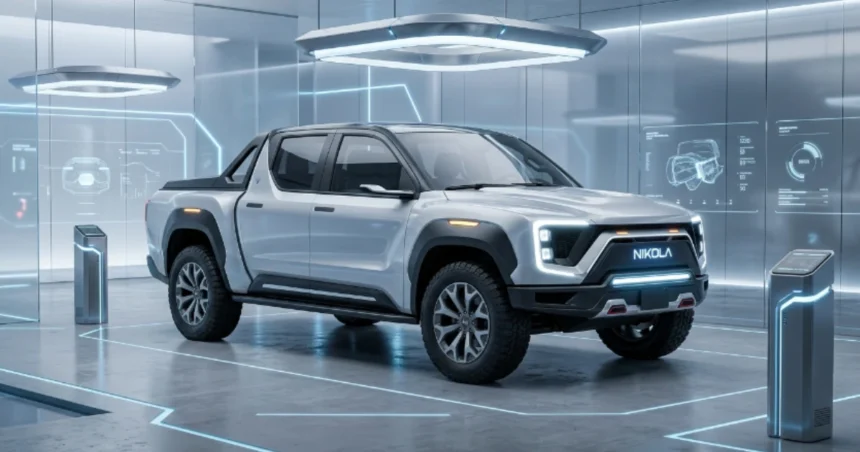
Few vehicles in automotive history have generated as much buzz, controversy, and confusion as the Nikola Badger truck. Announced in 2020 by Nikola Corporation, the Badger promised to be a genre-defining electric pickup, blending hydrogen fuel-cell technology with battery power to deliver supercar-like performance and hundreds of miles of range. Backed briefly by automotive giant General Motors, the Badger seemed poised to compete directly with the Tesla Cybertruck, Ford F-150 Lightning, and Rivian R1T. Yet within months, the project collapsed amid fraud allegations against founder Trevor Milton. This article traces the complete story of the Nikola Badger truck — from its dramatic unveiling to its bizarre 2024 resurrection and Nikola’s eventual 2025 bankruptcy.
What Is the Nikola Badger Truck?
The Nikola Badger truck was an electric pickup concept revealed by Nikola Corporation, a company better known for its hydrogen-electric semi-trucks. Unlike a conventional EV, the Badger was designed as a dual-powertrain vehicle, capable of running on either a lithium-ion battery pack or a hydrogen fuel cell, giving drivers flexibility depending on trip length. Nikola marketed the Badger as a rugged, high-performance work truck aimed at consumers who wanted both zero-emission capability and long-distance usability — something battery-only trucks of that era struggled to offer. The Badger was central to Nikola’s broader ambition of expanding beyond commercial trucking into the consumer pickup market.
The Origins of the Nikola Badger
Nikola Corporation, founded in 2014 (some records cite 2015) by entrepreneur Trevor Milton, initially focused on Class 8 hydrogen-electric semi-trucks. The idea for a pickup truck emerged later, as Milton sought a flashy consumer product to build public excitement around the Nikola brand. The Badger was designed to showcase Nikola’s fuel-cell technology in a smaller, more relatable package than an eighteen-wheeler. Early sketches hinted at a bold, angular design language that set it apart from traditional pickups, aligning with the futuristic aesthetic the company wanted associated with its name.
A Response to the Tesla Cybertruck
Interestingly, the Nikola Badger truck was first teased in late 2019, shortly after Elon Musk unveiled the polarizing Tesla Cybertruck. Milton publicly mocked the Cybertruck’s unconventional angular shape and offered his more conventionally styled Badger design as something Tesla could “borrow.” This rivalry-driven teaser generated significant media attention, positioning the Badger as a direct challenger in the emerging electric pickup segment well before any prototype existed.
Who Founded Nikola Corporation?
Trevor Milton founded Nikola Corporation with ambitions to disrupt the trucking industry using hydrogen and battery-electric technology. Milton became the public face of the company, frequently comparing Nikola’s trajectory to Tesla’s rise. He served as CEO and later executive chairman before resigning in September 2020 amid mounting scrutiny. Milton’s charismatic but controversial leadership style shaped much of the Nikola Badger truck’s early hype, and his later legal troubles would directly determine the vehicle’s fate.
Key Specifications and Features of the Nikola Badger
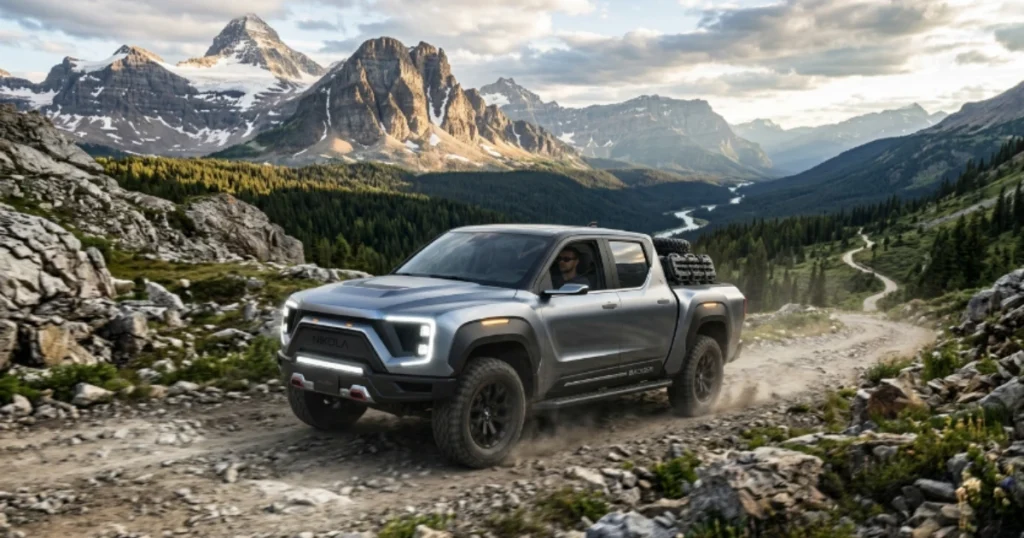
Nikola released ambitious specifications for the Badger long before any working prototype was publicly demonstrated. The company claimed the truck would deliver over 906 horsepower and 908 pound-feet of torque, figures more associated with supercars than pickups. Nikola also promised a 0-60 mph time of just 2.9 seconds and a towing capacity exceeding 8,000 pounds. These numbers were designed to position the Badger not just as an eco-friendly alternative, but as a genuine performance vehicle capable of outclassing gasoline-powered rivals in raw acceleration.
Powertrain: Battery and Hydrogen Fuel Cell Combo
What truly distinguished the Nikola Badger truck from competitors was its hybrid powertrain concept. Nikola stated the vehicle would offer around 300 miles of range on battery power alone, extending to roughly 600 miles when using both the battery and hydrogen fuel cell together. This dual-source approach was meant to solve the range anxiety associated with pure battery-electric trucks, especially for buyers in areas lacking dense charging infrastructure. The fuel cell would rely on hydrogen refueling stations Nikola planned to build alongside its semi-truck network.
Performance Numbers
Beyond straight-line speed, Nikola touted the Badger’s ability to power external construction equipment directly from its battery, a feature aimed at tradespeople and outdoor workers. The company suggested this functionality could replace portable generators on job sites. While these figures generated excitement, skeptics noted that Nikola had not yet built a functioning prototype capable of demonstrating these claims publicly, a red flag that would later prove significant.
The Nikola Badger Pre-Order and Reservation Process
In June 2020, Nikola opened reservations for the Badger with a $5,000 deposit, despite having shown only renderings rather than a physical vehicle. Orders placed before November 15, 2020 received a deposit match as an incentive. Reservation holders were also promised tickets to Nikola World 2020, a planned reveal event in Arizona featuring a live concert and ride-along experiences. The event was later canceled due to pandemic-related restrictions, and it was ultimately never rescheduled before the entire Badger program was shelved.
The General Motors Partnership
The Nikola Badger truck’s most credible moment came in September 2020, when General Motors announced a partnership to manufacture the vehicle. Under the proposed deal, GM would build the Badger using its Ultium battery platform — the same technology behind the GMC Hummer EV — and supply hydrogen fuel-cell components. In exchange, GM would receive an 11% equity stake in Nikola, valued at roughly $2 billion at the time, plus up to $700 million for manufacturing costs. This partnership briefly lent enormous legitimacy to Nikola’s ambitious pickup truck plans.
The Hindenburg Research Report and Fraud Allegations
Just two days after the GM deal was announced, short-selling research firm Hindenburg Research published a scathing report accusing Nikola of misleading investors about its technology. The report alleged that a widely circulated promotional video showing a Nikola semi-truck “driving” was actually filmed while the vehicle rolled downhill, with no functioning powertrain. This revelation triggered a U.S. Department of Justice investigation and severely damaged Nikola’s credibility, casting doubt over every claim the company had made, including those surrounding the Badger’s performance specifications.
Cancellation of the Nikola Badger Program
By late November 2020, the fallout proved fatal for the Badger project. Nikola announced that the truck would not be produced at all, stating that the revised, scaled-back GM agreement excluded any equity stake or Badger development commitments. The company confirmed it would refund all customer deposits, though no clear timeline was given. Nikola shifted its full focus back to Class 7 and Class 8 commercial trucks, effectively ending the Badger’s original consumer pickup ambitions less than a year after its public debut.
Trevor Milton’s Fraud Conviction and Presidential Pardon
Following his resignation, Trevor Milton was indicted on securities and wire fraud charges. In October 2022, he was convicted and later sentenced to four years in federal prison, along with forfeiting a 4,678-acre Colorado ranch and paying a $1 million fine. Nikola separately settled with the SEC for $125 million over the misleading claims. In a dramatic twist, Milton received a full presidential pardon from Donald Trump, reigniting public debate about accountability in the Nikola saga and setting the stage for renewed interest in reviving the Badger brand.
The Badger’s Surprising Comeback: Embr Motors
In February 2024, the Nikola Badger truck resurfaced unexpectedly. Nikola sold the Badger’s intellectual property, along with its two existing prototypes, to a new company called Embr Motors. The deal, reportedly worth “tens of millions” of dollars, gave Nikola a 30% equity stake in the new venture. Nikola’s chief legal officer, Britton Worthen, confirmed the sale on a conference call, describing it as a way to potentially retain value for shareholders if the Badger ever reached production under its new ownership.
Dave “Heavy D” Sparks and the Diesel Brothers Connection
The buyer behind Embr Motors was Dave “Heavy D” Sparks, a television personality known from the Discovery Channel show Diesel Brothers, alongside business partner Cole Cannon. Sparks announced the acquisition via YouTube, revealing the two surviving Badger prototypes and driving one on camera to demonstrate functionality. He described Milton as a “longtime friend,” a comment that drew criticism given Milton’s fraud conviction. Sparks also acquired Nikola’s abandoned off-road vehicle and personal watercraft assets, though he stated no firm production timeline for the Badger’s eventual release.
Nikola Corporation’s Chapter 11 Bankruptcy
While the Badger brand quietly changed hands, Nikola Corporation itself continued struggling financially. On February 19, 2025, Nikola filed for Chapter 11 bankruptcy in the U.S. Bankruptcy Court for the District of Delaware, listing liabilities between $1 billion and $10 billion against assets of just $500 million to $1 billion. The company entered bankruptcy with only about $47 million in cash, having failed to secure a buyer or raise sufficient capital despite approaching more than twenty potential investors. Nasdaq subsequently issued a delisting notice, and NKLA shares were suspended from trading shortly after.
What Happened to Nikola’s Assets After Bankruptcy?
Nikola pursued a Section 363 asset sale during its bankruptcy proceedings, with substantially all remaining assets ultimately sold to Lucid Group. The bankruptcy court confirmed a liquidating plan on September 12, 2025, which became effective on December 12, 2025, transferring control of remaining estate matters to the Nikola Liquidating Trust. Separately, a company called Hyroad Energy won a bankruptcy auction for other Nikola assets in August 2025 and announced plans to restore digital connectivity for existing Nikola Tre trucks still operating in the field. By late 2025, Nikola’s workforce had been reduced to a single employee overseeing the wind-down.
Current Status of the Nikola Badger Truck (2026)
As of 2026, the Nikola Badger truck remains disconnected from Nikola Corporation itself, which no longer exists as an operating company following its liquidation. The Badger’s future now rests entirely with Embr Motors, which has not announced a confirmed production timeline, pricing, or wider funding round since acquiring the intellectual property in 2024. No additional prototypes beyond the original two have been publicly confirmed, and the broader electric pickup market has since matured considerably with established players like the Cybertruck, F-150 Lightning, and Rivian R1T already in customers’ hands. Whether the Badger nameplate ever reaches genuine mass production remains uncertain.
Comparing the Nikola Badger to Rivals
When first announced, the Nikola Badger truck was positioned against an emerging class of electric pickups. The Tesla Cybertruck eventually launched with angular styling and strong performance variants. The Ford F-150 Lightning brought electric power to America’s best-selling truck nameplate, while the Rivian R1T carved out a premium adventure-focused niche and the GMC Hummer EV leaned into extreme off-road capability. Unlike these rivals, the Badger never reached even limited production, meaning direct performance comparisons remain purely theoretical rather than based on real-world testing or customer ownership experience.
Lessons from the Nikola Badger Saga
The story of the Nikola Badger truck offers a cautionary tale about the dangers of overhyping unproven technology in the electric vehicle industry. Nikola accepted tens of thousands of dollars in customer deposits for a vehicle that existed only as renderings, while simultaneously making performance claims that were never independently verified. The collapse of the GM partnership, the Hindenburg report, and Milton’s eventual fraud conviction collectively illustrate how quickly investor and consumer trust can evaporate when marketing outpaces engineering reality in the fast-moving EV startup space.
The Legacy of the Nikola Badger
Despite never reaching production, the Nikola Badger remains a notable case study in electric vehicle history, frequently referenced alongside other ambitious but troubled EV startups. Its brief partnership with General Motors demonstrated how seriously legacy automakers once viewed Nikola’s technology, even if that confidence proved premature. The truck’s unusual afterlife under Embr Motors also highlights how automotive intellectual property can outlive the companies that originally created it, continuing to generate public curiosity years after the original announcement.
Conclusion
The Nikola Badger truck stands as one of the most dramatic stories in modern automotive history — a vehicle that promised supercar acceleration, hydrogen-electric versatility, and a genuine challenge to Tesla, only to collapse under the weight of fraud allegations before a single unit reached a customer’s driveway. From its flashy 2020 unveiling and short-lived General Motors partnership to Trevor Milton’s fraud conviction, pardon, and Nikola Corporation’s eventual 2025 bankruptcy, the Badger’s journey reflects both the promise and peril of the electric vehicle startup boom. Its unexpected 2024 revival under Embr Motors keeps the door open for a future comeback, but as of 2026, the Nikola Badger truck remains more legend than reality.
Frequently Asked Questions (FAQs)
1. What is the Nikola Badger truck? The Nikola Badger truck was an electric pickup concept announced by Nikola Corporation in 2020, designed to combine battery power with hydrogen fuel-cell technology for extended range and high performance.
2. Did Nikola ever actually build the Badger? Nikola built only two prototype units before canceling the consumer production program in late 2020, following the collapse of its General Motors partnership.
3. Why was the Nikola Badger canceled? The project was canceled after a Hindenburg Research report exposed misleading claims about Nikola’s technology, leading General Motors to scale back its involvement and remove Badger development from the revised agreement.
4. Who owns the Nikola Badger truck now? As of 2024, the Badger’s intellectual property and prototypes belong to Embr Motors, a company founded by television personality Dave “Heavy D” Sparks, with Nikola holding a minority equity stake.
5. Is Nikola Corporation still in business? No. Nikola Corporation filed for Chapter 11 bankruptcy in February 2025, sold its assets through a court-approved process, and its liquidating plan became effective in December 2025.
6. Will the Nikola Badger truck ever be produced? There is no confirmed production timeline. Embr Motors has expressed interest in bringing the Badger to market, but no funding, manufacturing partner, or release date has been officially announced as of 2026.
7. What happened to Nikola founder Trevor Milton? Trevor Milton was convicted of securities and wire fraud in 2022 and sentenced to four years in prison, but he later received a full presidential pardon from Donald Trump.